

Four days—that’s how much time teachers and students will be missing out on instruction as West Covina Unified School District has begun a new four-day AI Pilot program led by the consulting firm AI InnoVision.
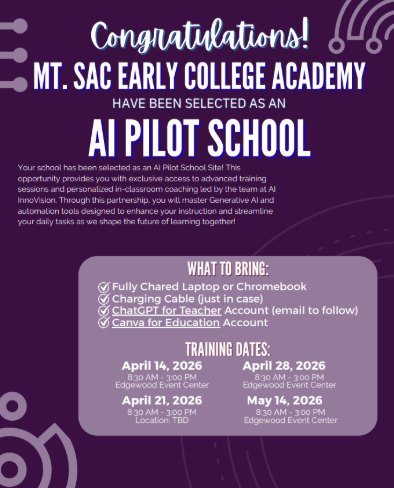
The goal of the program is to integrate AI into teacher curricula in an effort to improve learning.
Yet, what may have started innocently enough has already created issues for staff and students, conflicting with CAASP testing, replacing educators, and outright contradicting existing restrictions on students.
“Our state testing had to be moved up,” said Jeanne Berrong, who teaches 10th, 11th, and 12th-grade English at MECA. “I had to literally throw away my summative assessments because we had to immediately start state testing.”
But what was so important that testing needed to be moved and all teachers needed to be absent from the classroom?
Teachers spent the first training learning how to use AI to send out emails and make effective lesson plans for students, generating basic points, quizzes, and tests from their teacher guides on April 14 at Edgewood Conference Center.
“Old school, what I would do is I would take the student book, read the chapter, highlight what I liked, and then I would have to type that into a presentation, type that into a test,” said Gabriel Nichols, government and economics teacher at MECA. “So what I can do [with] AI now in like 15, maybe 30 minutes, used to take me three to four hours.”

During the second training on April 21, educators were taught to train AI to think a certain way.
So instead of making their own lessons or writing their own emails, educators are typing in a generic sentence, asking the chatbot to provide the work, and even training the bots to sound like them.
Doesn’t this sound a little too familiar?
Teachers are essentially plagiarizing, though neither the administration nor the district will admit it.
“What’s really absent from our conversations is we’re not talking about the ethical use of AI,” Berrong said. “For instance, if my supervisors evaluate me and they have AI write my evaluation, are they really evaluating me? And if I only evaluate my students using AI, am I really evaluating them?”
The program comes at more than the cost of academic integrity: at the WCUSD Board Meeting on October 14, one of the first (and few) times the program was publicly announced, WCUSD Superintendent Emy Flores stated that the program’s budget would not exceed $350,375, the equivalent of three years of one teacher’s annual salary.
On top of it all, the path forward seems unclear.
“There’s no format for us to follow… It’s a pilot program that is designed by us,” said a WCUSD board insider. “But we’re already handing it out to teachers and training people on these initiatives without having any sort of research based off of this.”
Furthermore, the AI InnoVision program doesn’t even specialize in advancing education.
On the AI InnoVision website, some pages mention they serve corporations, small businesses, government agencies, and non-profit organizations, but there is no direct or even remote mention of education. However, facilitators of the training are a former school principal and a special education teacher.
Google even offers a program to implement AI into schools. As a Google district, this service would make the most sense for our district to choose. Students and staff all have Google accounts, Chrome computers, and use Google tools like Google Docs and Slides.
Since AI InnoVision is just a consulting company and doesn’t have its own AI chatbots (like Google’s Gemini or Anthropic’s Claude), teachers had to use ChatGPT and Gemini. This furthers the question of why the district chose to use these companies over others in the first place.
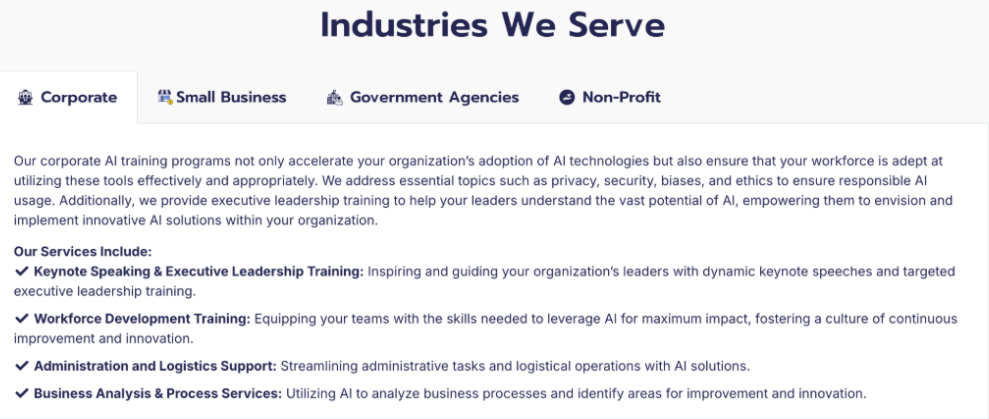
Even their founder, Alicia Lyttle, has no formal background in education. According to her bio on the AI InnoVision website, she has 23 years of experience in digital marketing and is now a “highly sought-after trainer in artificial intelligence.”
Her bio also adds that the company offers solutions for corporations and organizations, but not education.
In the end, as opposed to what has been stated, this AI training is currently taking away from class time; all MECA teachers and administrators were replaced by substitutes, unbeknownst to students and parents, who found out the week before the first training.
According to an anonymous MECA teacher, the school did not tell the teachers to mention this fact at all. In fact, when teachers originally found out about this program, the school told them not to inform students or parents at all. Teachers chose to inform students on their own to make sure they were aware of the situation.
As a student, I am extremely confused as to why they chose to do this now rather than during the summer, when it would not conflict with class time.
“I think that they are thinking ahead. So they’re thinking about next year, yeah, but I’m swimming in this year,” said Berrong. “From their perspective, I’m sure this seems like a good but unfortunate, an unintended effect, yeah, of scheduling, but I still have to teach this year.”
Even with the concerns, Flores has been a strong advocate for this program, saying in a video posted on Instagram by @westcovinausd on April 5, that “we must embrace AI, leverage AI, and figure out ways to improve teaching and learning using AI as a tool.”
Additionally, the district is trying to make it seem like they are the ones to first implement AI into education.
“The district kept mentioning that we’re one of the only districts doing this, and it’s like you’ve got to remember that’s for a reason,” said the WCUSD board insider. “There’s a reason these initiatives haven’t been rolled out district-wide at other districts, at such a fast pace, at the level that we’re doing it right now. And I think the district is kind of ignoring those reasons to be the face of it, to make us seem like we were…the pioneers.”
The rest of the training will take place on April 28 and May 14, two more days when MECA teachers and administration will be learning how to replace themselves with AI.
Ultimately, this program would be much more effective if the district had taken the time to realize how this training is affecting instruction and student learning, as well as making sure the training put a much larger emphasis on the ethical use of AI among educators.
Teachers wonder if students can be trusted to use AI ethically, but now that AI is being frequently used by teachers, the real question is whether the adults can be trusted.